Author: Rahul Kumar Shaw
Course: B.Tech in Information Technology (3rd Year)
Institute: Meghnad Saha Institute of Technology
Introduction
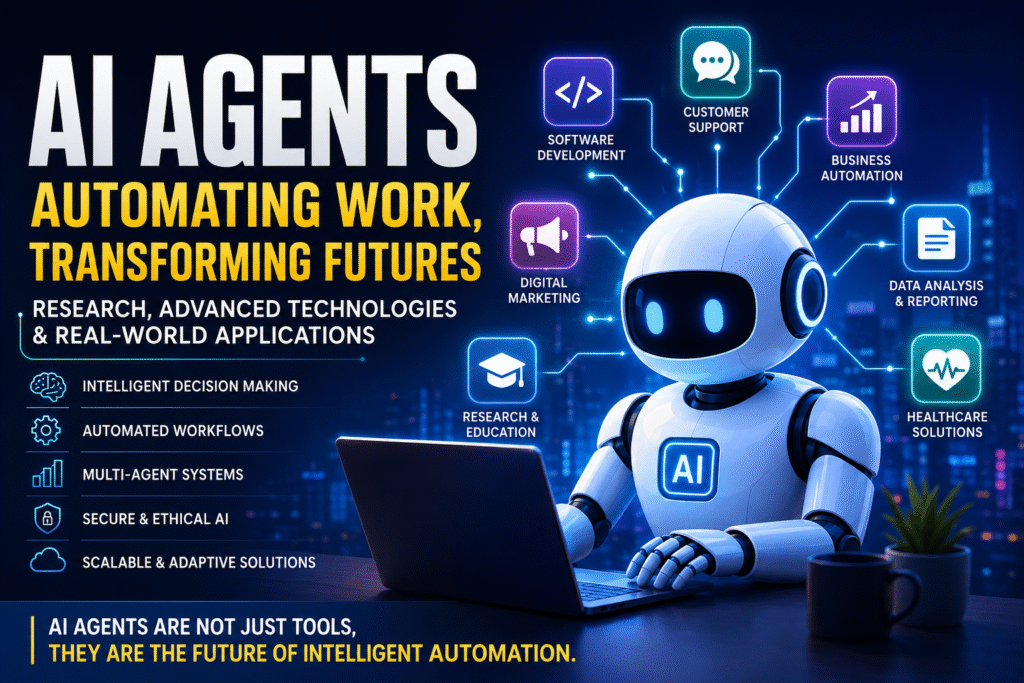
Artificial Intelligence has progressed beyond rule-based automation into a phase where autonomous intelligent agents can perform complex tasks with minimal human intervention. These AI Agents are capable of perception, reasoning, learning, and action, making them central to the automation of modern digital workflows.
Recent research in AI agent architectures, reinforcement learning, and large-scale language models has accelerated the adoption of intelligent agents across industries. This blog examines AI agents from a research and advanced-technology perspective, highlighting their architecture, underlying technologies, real-world automation use cases, and future research directions.
Understanding AI Agents from a Research Perspective
In artificial intelligence research, an AI agent is defined as an entity that perceives its environment through inputs and acts upon that environment using intelligent decision-making mechanisms to achieve specific goals.
Modern AI agents differ from traditional automation systems due to their ability to:
- Adapt to changing environments
- Learn from historical data
- Reason using probabilistic and contextual models
- Operate autonomously for extended periods
Research in this field focuses on making agents more robust, explainable, and ethically aligned.
Core Technologies Powering Advanced AI Agents
1. Large Language Models (LLMs)
LLMs enable AI agents to understand context, generate human-like responses, write code, and reason over complex instructions. When integrated with tools and APIs, LLM-powered agents can autonomously execute multi-step tasks such as research analysis, document generation, and workflow orchestration.
2. Reinforcement Learning (RL)
Reinforcement Learning allows AI agents to learn optimal actions through trial and error by interacting with environments. RL is widely researched for:
- Autonomous decision-making systems
- Robotics and industrial automation
- Resource optimization problems
This learning paradigm enables agents to improve performance over time without explicit programming.
3. Multi-Agent Systems (MAS)
In advanced research, multi-agent systems involve multiple AI agents working collaboratively or competitively. These systems are used in:
- Distributed computing
- Smart traffic control
- Financial market simulations
- Swarm robotics
Coordination, communication, and negotiation between agents are key research challenges in MAS.
4. Knowledge Graphs and Reasoning Engines
Knowledge graphs provide structured relationships between data entities, allowing AI agents to perform logical reasoning and inference. When combined with symbolic AI, agents can explain decisions, improving transparency and trust.
5. Cloud Computing and Edge AI
AI agents leverage cloud platforms for scalability and edge computing for low-latency decision-making. This combination enables:
- Real-time automation
- Distributed agent execution
- High availability and fault tolerance
Automation of Complex Workflows Using AI Agents
Software Engineering Automation
AI agents assist in:
- Code synthesis and refactoring
- Automated testing and debugging
- Continuous integration and deployment monitoring
Research shows that agent-based development environments significantly reduce development time.
Enterprise and Business Automation
AI agents automate:
- Intelligent document processing
- Financial analysis and forecasting
- Supply chain optimization
These systems integrate AI agents with ERP and CRM platforms for end-to-end automation.
Scientific Research and Data Analysis
AI agents support researchers by:
- Reviewing large volumes of literature
- Summarizing research papers
- Identifying patterns in experimental data
Such agents accelerate innovation in data-intensive domains.
Cybersecurity and Network Monitoring
AI agents are deployed to:
- Detect anomalies in network traffic
- Respond to cyber threats autonomously
- Predict potential vulnerabilities
This proactive security approach is a major research focus.
Ethical AI and Research Challenges
Despite their advantages, AI agents raise important concerns:
- Bias in training data
- Lack of explainability in decision-making
- Security risks in autonomous systems
- Human job displacement concerns
Current research emphasizes Explainable AI (XAI), fairness-aware models, and responsible AI governance frameworks to address these challenges.
Role of IT Students in AI Agent Research and Development
For B.Tech IT students, AI agents represent a convergence of multiple disciplines:
- Data structures and algorithms
- Machine learning and AI
- Distributed systems
- Cloud architecture
- Software engineering principles
Understanding AI agents prepares students for careers in AI research, automation engineering, data science, and intelligent system design.
Future Scope of AI Agents
Ongoing research aims to develop:
- Self-improving autonomous agents
- Emotion-aware and socially intelligent agents
- Human-AI collaborative systems
- Fully autonomous digital organizations
AI agents are expected to become foundational components of next-generation digital infrastructure.
Conclusion
AI agents represent a transformative advancement in automation technology. Powered by cutting-edge research in machine learning, reinforcement learning, and multi-agent systems, these intelligent entities are redefining how work is performed across industries.
As a B.Tech Information Technology student, gaining knowledge of AI agents and their underlying technologies is crucial for contributing to future intelligent systems. With responsible development and strong academic foundations, AI agents can be leveraged to build efficient, ethical, and sustainable digital solutions.